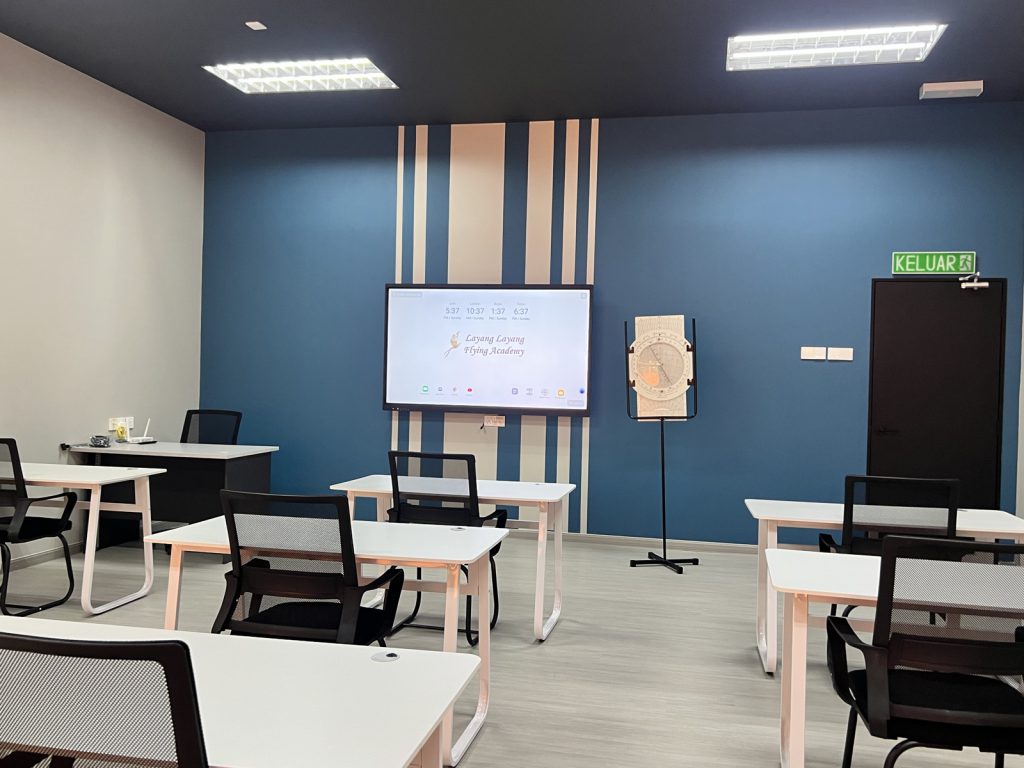
Most people who enquire about professional pilot training are picturing the flying. The reality of the first months is a classroom, a stack of notes and a timetable that looks more like a university degree than an aviation adventure. On our Commercial Pilot Licence with Instrument Rating programme the published structure is 850 hours of ground school against 200 hours of flying — theory is, by volume, the largest single part of the course.
This guide explains what those 850 hours contain, how they are taught, and why the students who take them seriously fly better later.
Why the theory comes first
A commercial licence is a licence to make decisions with other people’s lives attached to them. Almost every one of those decisions rests on knowledge that cannot be improvised in the cockpit: whether the weather ahead is legally and practically acceptable, how much fuel a diversion needs, what a particular system failure means, where the terrain is in cloud.
Airline Transport Pilot Licence theoretical knowledge is set at the level required for airline operations rather than at the level required to pass a single flight. That is deliberate. It is also why the syllabus feels heavier than the aircraft you are flying at the time seems to justify.
What 850 hours actually looks like
Spread over the theory phase, that figure translates into full-time study. A typical week is built from three components:
- Instructor-led lectures. Subject by subject, in a classroom, with worked examples and questions taken as they arise.
- Supervised and private study. Reading ahead, working through practice questions, and consolidating what was taught that day while it is still fresh.
- Progress testing. Regular assessments that show — to you and to the instructors — whether a subject has actually landed before the syllabus moves on.
The rhythm matters more than the total. Subjects are examined in blocks, and each block builds on the last. A week lost is rarely a week; it is a week plus the time needed to catch up on everything taught while you were behind.
The subjects, and how they connect
The syllabus covered on our programme spans the following areas:
- Air Law. The rules that define what you may do, where, and under what conditions — including licensing, rules of the air and airspace.
- Human Performance and Limitations. How the body and mind fail: fatigue, hypoxia, spatial disorientation, workload and decision-making under stress.
- Meteorology. The atmosphere as an operational problem: thunderstorms, visibility, icing, wind, and how forecasts are constructed and read.
- Navigation and Flight Planning. Getting from one place to another accurately, legally and with the fuel to do it, including the mathematics behind it.
- Principles of Flight. Why the aeroplane behaves as it does — lift, drag, stability, stalling and the limits of the envelope.
- Aircraft General Knowledge. Airframes, engines, electrics, hydraulics and instruments, and what each failure means to a pilot.
- Operational Procedures. How commercial operations are actually run, including performance, loading and abnormal situations.
- Radio Telephony and Communications. Standard phraseology and the discipline of clear, unambiguous exchanges with air traffic control.
They are taught as separate examinations but they are not separate in the air. A single decision to divert draws on meteorology, navigation, operational procedures, air law and human performance at once. We cover each subject in more detail in the Airline Transport Pilot Licence theory subjects, explained one by one.
How the examinations work
Progress within the academy is measured continuously, but the examinations that count towards the licence are set and administered under Civil Aviation Authority of Malaysia arrangements. Sittings, resit rules and the validity period attached to a completed set of theory credits are all governed by the authority and change from time to time — confirm the current position with Admissions rather than relying on a forum post or an overseas syllabus.
What does not change is the planning implication: the theory credit that gives you a Frozen Airline Transport Pilot Licence has a shelf life. Your flying and your examinations should progress together rather than leaving a long gap between the two.
Study methods that work
In our experience the students who come out of ground school comfortably do a small number of things consistently:
- They study daily rather than intensively. Two focused hours every evening beats twelve hours the weekend before an examination.
- They use question banks as a diagnostic, not a syllabus. Practice questions are for finding the gaps. Memorising answers produces a pass and a pilot who cannot apply the material.
- They ask early. Instructors can fix a misunderstanding in five minutes on the day. The same misunderstanding, three subjects later, takes an evening.
- They rewrite rather than reread. Condensing a topic into your own one-page summary tests recall in a way that highlighting does not.
- They study with other cadets. Explaining meteorology to someone else is the fastest way to discover whether you understand it.
Where students fall behind
The failures we see are rarely about intelligence. They are about pattern:
- Treating ground school as something to fit around a job or a social calendar.
- Leaving the weakest subject until last, so the pressure and the difficulty peak together.
- Underestimating the mathematics in navigation and flight planning after years away from it.
- Assuming the flying phase will be a break. It is more demanding, and it runs alongside continued study.
Where the theory shows up in the aircraft
The connection becomes obvious quickly. A cadet who genuinely understands meteorology briefs a marginal day differently. A cadet who understands principles of flight recovers from a developing stall rather than reacting to it. A cadet who has internalised air law does not have to reason from first principles about who has right of way while also flying an aeroplane.
Ground school is not a gate you pass through on the way to the interesting part. It is the reason the interesting part is survivable.
Before you start
If you are still weighing the programme, the useful preparation is unglamorous: refresh secondary-school mathematics and physics, get comfortable reading technical English, and arrange your Class 1 medical assessment before committing money to anything else. We cover the rest in how to prepare before day one.
See the full Commercial Pilot Licence with Instrument Rating programme, check the entry requirements, or speak to Admissions about intake timing. Programme details are subject to Layang Layang Flying Academy confirmation, the approved syllabus and applicable Civil Aviation Authority of Malaysia requirements.